We did lots of work with the staysail on the J/109, and it was very efficient in most conditions. We tacked it to a padeye just aft of the anchor box locker.
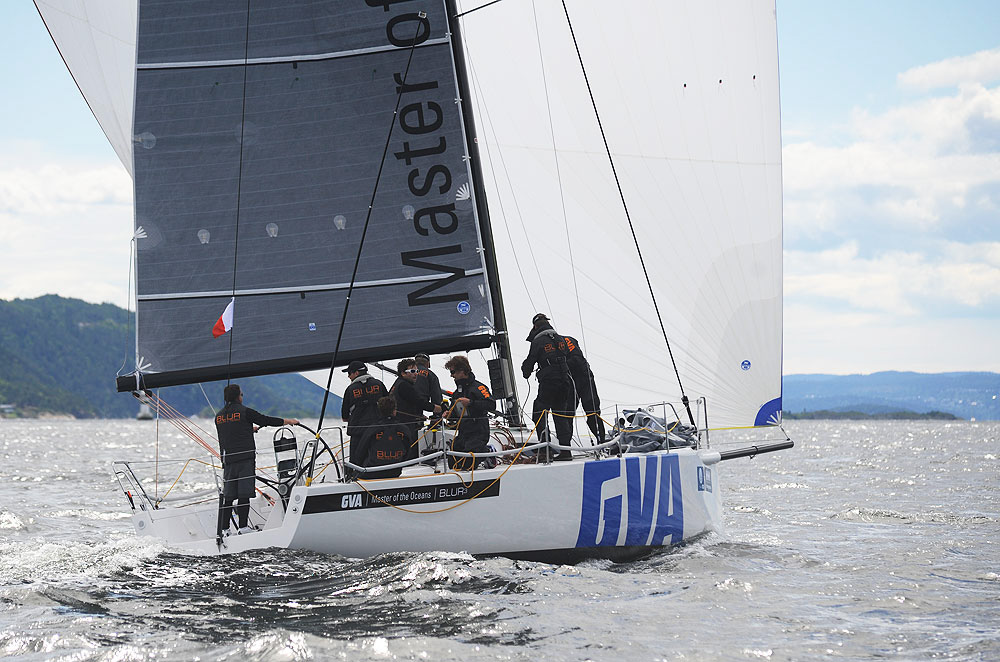
With the same setup on the J/111 we got almost no effect. Here’s a shot from Tjörn Runt 2014… trim (and crew position) looks bad, but the difference in geometry is apparent.
Distance from the gennaker tack to the main on the J/109 is 4.05+1.67=5.72 and on the J/111 4.22+2.43=6.65, 16% longer.
We tried several different tacking points, ending up quite far aft. As seen on the first photo, it’s about 100 cm aft of the previous padeye and 50 cm in front of the hatch.
The main effect of the staysail is to increase the flow on the back of the main, and the bigger STL on the J/111 makes the geometry quite different compared to most boats.
You can see the same thing on many bigger modern boats, where the staysail ends up closer to the mast.
Now we’re getting 2-3% speed increase in most conditions, so well worth the effort.
Now we run the staysail from TWS ~6 knots up to 18 knots when we’re planing, and keep the jib up instead.
We need to get some better phots of the sail plan in 2020 :-)
If you want to go full nerd:
THE EFFECTS OF STAYSAILS ON YACHT PERFOMANCE
D.J. Le Pelley, L. Kjellberg, R.G.J. Flay
Abstract. A staysail can be defined as any supplementary sail flown between the mast and primary genoa or spinnaker to enhance aerodynamic performance. Much of the time, huge expense and effort is put into improving the performance of the flying sails with little thought to staysail design and position. Wind tunnel experiments were carried out in the University of Auckland’s Twisted Flow Wind Tunnel on a range of staysails operating under typical flying sails. Flow visualisation of interesting concepts was carried out. The analogy of the staysail as a turning vane that improves the flow over the other sails was investigated. Independent supports were used to determine the load contribution of the staysail to the overall loading of the sail combination. A range of clew heights of the staysail were investigated. A significant gain in driving force of around 10% on average and up to 17% has been demonstrated by correct selection and placement of staysails. Staysail area is not a key factor, with the smallest staysail testing giving one of the largest improvements. Masthead staysails and sailing triple-headed were both found to have a significant performance benefit over a conventional medium sized staysail.
Intressant om undanvindssegel. Verkar finnas två skolor just nu… många mindre segel (ofta cable-less med mindre halvbredd) tillsammans vs stora genankers.
De flesta av frågorna i olika shorthadedforum handlar om autopiloter, och jag tyckte att Pelle Lindell redde ut skillnaden mellan olika varianter på ett bra sätt:
I grunden är det med autopilot som med mycket annat att det finns ingen magisk lösning utan man måste bestämma sig vad man vill att piloten skall klara och sen får man ta kostnaden. I princip finns det fem nivåer på förmåga och kostnad:
1. Simpel rorkultspilot (Ray ST2000 eller motsvarande Simrad) som kan föväntas styra för motor och segla i lätt vind och platt vatten. Kostnad 5 kkr
2. Bättre rorkultspilot (Raymarine EV-100 och Pelagic) som kan förväntas segla bra i måttlig vind och sjö och korta stunder i högre vågor. Nackdelen är att drivenheten måste lyftas av manuellt när man vill styra själv. Kostnad typiskt 15-20 kkr
3. Standardpiloter med fast installerad drivenhet. Typiska produkter är Raymarine EV-200 och B&G (Simrad) NAC2 och NAC3. Kostnad typiskt 30-40 kkr. Piloten förmåga är liknade som en nivå2 pilot men den kan givetvis kopplas i och ur med ett knapptryck.
4. Bästa sortens konsumentpiloter. Det finns två alternativ, NKE-gyropilot och B&G-H5000 piloten. Med rätt instrumentsystem, inställning och kalibrering kan man förvänta sig att piloten seglar bra i de flesta förhållanden, även med spinnaker i sjö. Men man skall vara medveten att det kan krävas pillande med inställningar. B&G är idag mer användarvänlig. Kostnad 50kkr + instrument.
5. Proffsystem för IMOCA och class 40. Tex. NKE-HR-pilot. Inget för oss vanliga dödliga. Kostnad från 100 kkr och uppåt för systemen.
Jag anser att den första väsentliga frågan är vilken nivå på pilot man vill ha. Valet av fabrikat är mest beroende på vilka instrument man har har i båten idag för det finns en viss ide att hålla sig till ett fabrikat.
Efter att ha bestämt sig för en pilot, så bör man också ha med i beräkningarna att det tar tid att lära sig att segla med den. Ingen pilot kommer “magiskt” att klara av en slör i 10 m/s utan man behöver träna och komma fram till vilka inställningar som funkar.
Tänkte att vi kunde ha denna tråd för att lägga ut sådant vi inte behöver, men som kanske någon annan har nytta av.
Till exempel finns det en jättefin kolfiberratt från Lewmar med diameter på 1200 mm. Maila peter@blur.se så förmedlar jag kontakt med Charlotta som har den.
Nothing new under the sun Here’s a great piece from between 1972-1974.
Thanks to Pelle Pedersen for keeping stuff like this.
CRISIS shows what the double head rig is all about. Here she is just barely cracked off-the-wind and really powering! The genoa staysail lead is at about 8° from its own tack. The main twist is perfectly married up to the inside sails.
For close reaching and in many cases for going to windward, a double head rig (high clewed reacher or jib topsail plus genoa staysail) gives a distinct advantage over a genoa. Even on boats carrying a Starcut spinnaker, a reåcher and staysail arean essential combination. First of all, even in light wind, the Starcut can never be carried closer to the wind than 50° or 55° with advantage over the reaching double head rig. Therefore, there’s a fairly wide angle–say between 35° and 50°–when the double head rig is much faster than any other combination of sails. As the wind freshens, it rapidly becomes impossible to carry a Starcut spinnaker close to the wind and then the reacher becomes even more important since it will be used with wind much further aft. See drawing on page 2 The reacher (jib topsail) isa dacron sail of the same area as the #1 genoa (unless the #1 hasa very large overlap) cut with the clew as high as possible @ and with the sheet led to the quarter of the boat–probably where the spinnaker sheet blocks are mounted. The reacher is used with the apparent wind between 35° and wherever the Starcut can be carried-say 55° or so in moderate air and 90-950 in a fresh breeze.
The genoa staysail or reacher stay sail has about 40% of the area of the reacher and is flown under it like a small genoa. It is hoisted flying on a wire halyard (which usually doubles as a topping lift) (b) mounted roughly 1/3 of the I dimension below the masthead. The tack is set about 1/3 of J aft (d) on the centerline of the foredeck. Alternately, the staysail can be de signed to set on the free genoa halyard and tacked a bit further aft. (c) The tack fitting can either be a fixed pad eye or better a slider on a length of genoa track running fore and afton the foredeck centerline to provide variable tack position for this sail and the spinnaker staysail. The staysail is sheeted outside the shrouds to the genoa track on a fairly wide reach but under the spreader and between the shrouds (upper and lower) on tight reaches if the shrouds are quite far outboard.
Reaching a double head rig is distinctly faster than a genoa for several reasons. The mast important is that a sail like a genoa whose leech is appreciably longer than the foot, twists excessively when eased, the upper part falling off and luffing prematurely while the lower part cups in behind the main producing backwind and drag. Since a reacher hasa shorter leech anda longer foot than a genoa it can be set well eased (for reaching) without twisting off and thus the relative trim angle of the whole luff of the sail can be kept nearly constant.
Having the entire sail trimmed at the same angle to the wind adds up toa big plus in efficiency–more forward force and less side force.
The high foot of the reacher permits a big staysail to set inside with a minimum of interference. This is the second big plus for the double head rig. A great deal more sail can be set effectively than with a genoa even if a staysail is put up with the genoa. Other pluses: The reacher is cut rounder and fuller than a beating genoa; hence, more power. The reacher has more area aloft where the breeze is fresher and less turbulent. The reacher never picks up the bow wave the way a genoa does. And, it’s great for cruising–high clew, good versatility and plenty of speed for light air sailing!
For several years now, a number of boats have been using double head rigs very effectively for upwind work in light and medium air as well. One might expect that a very conclusive answer as to whether this is faster or slower than a genoa would have developed and everybody would either be using genoas or double head rigs by now. There seem to be two basic reasons why no consensus is possible. The fint is that same boats are designed fora double head rig and same are not. The other is that without doubt, same owners and crews could never get along with a double head rig while others get extremely good performance from the double head rig.
Dealing with the boat first, there are several things that influence whether a boat is appropriate for beating with a double head rig. First of all, we feel that a boat which makes its best upwind performance by pointing extremely high rather than by footing and going fast is probably not going to profit from a double head rig for beating. A slightly less close winded boat that can foot fast would be a good candidate for the double head rig.
The second thing that makes a double head rig a good choice is if the boat is intentionally rigged with a 150% overlap where she might normally carry a 170% for light air racing. This is often the case for boats that are going to compete in the Southern Circuit or in areas such as San Francisco Bay. In a boat that is slightly under-rigged, a 150% double head rig is definitely faster upwind than a 150% genoa and is a necessity. The real issue, of course, is on a rating basis whether a 170% genoa is enough faster than a 150% double head rig to make up for the difference in rating. If a choice has already been made to go to a 150% and this makes the boat a bit under-canvassed, then the double head rig should be used.
The third thing to consider is the relation of the length overall of the boat to the J measurement of the boat, or to the LP of the genoa to be used. If the boat has an extremely large J or LP and very short ends, the sheet lead for the jib topsail may be too far forward since the stern does not stick out far enough to move it aft. This forces the clew of the jib topsail to be lower and reduces the available room for the staysail to work. On the other hand, a boat with a relatively small foretriangle and a very long stern overhang is an ideal candidate for a double head rig since the jib topsail can have a very high clew and the staysail can have lots of room to work. To be effective, the jib topsail must not only have a sheet position well aft of the mast, but also a sheet lead angle that is fairly wide at the stern. A boat with fairly wide quarters would be a better choice than a boat with an extremely pinched in stern, since this would keep the jib topsail away from the mainsail.
Finally, and an extremely important consideration, we come to the type of rigging on the spar. The further up the spar the lowest spreader is, the bigger the staysail that can be set with its leech just clearing underneath the spreader. If a mast has double spreaders, or if the single spreader is extremely low and forces the hoat to use a relatively small staysail, this is something of a disadvantage. Even so, many double spreader rigged boats do very well with a double head rig, but it is not the optimum situation. Since a single spreader quite high on the mast is a feature of many older boats and also is a feature that interferes with the abili ty to use a genoa, these are ideal candidates for the double head rig.
The disposition of the lower shrouds is very important. This is an area where the owner’s attitude enters into it, since it often means a structural modification to the boat to get the optimum situation for the double head rig. First of all, a forward lower shroud is usually intolerable and has to be gotten out of the way one way or another. Usually a centerline babystay replacing the forward lower shroud is the best solution. Even getting the forward lower out of the way isn’t enough if the best staysail is to be built. The other lower shroud should either be well inboard or rigged over a mini-spreader. Dick Deaver on his Cal 33 fitted the lower shroud with a spreader in order to bring the shroud attachment at the deck further inboard and increase the size of the staysail that can be used. This has become the standard approach on many boats. On any given rig and sailplan we would have to work out exactly what the best options are to develop a double head rig that would be really effective.
One last thought on the characteristics of the boat is that a boat which is designed in such a way that using genoas effectively is nearly impossible becomes a candidate for a double head rig. Two things control the ability to sheet a genoa. One is the distance that the spreaders extend out from the mast, particularly high on the mast. On double spreader rigs the length of the upper spreader controls the sheeting of the genoa leech and on a single spreader rig both the height of the spreader and the length of the spreader control the sheeting of the genoa. The other thing that controls the genoa is the distance the shrouds are outboard of the mast at the deck. A boat with wide spreaders and shrouds well outboard at the deck can’t sheet a genoa properly and should try a double head rig.
Even if a boat were in mast senses appropriate for the double head rig, it might still be that in many owners’ hands a 170% genoa would give better performance on a rating basis than the double head rig. There are several reasons for this. First of all, it is hard to sail the boat at its optimum upwind with a double head rig simply because the helmsman’s view of the luff of the primary headsail is obscured by the staysail. The second factor is that the double head rig requires that the trimming of three sails interact properly rather than just two. The extra variable makes it difficult to reach the optimum trim. Another problem is that tacking the boat is more difficult and therefore more costly in an around-the-buoys race. These considerations make the double head rig much more appropriate for longer offshore races than for the shorter around-the-buoys racing with the first leg to windward.
Using the double head rig effectively upwind requires an owner and crew who have practiced with the rig and have learned to understand it and get the best out of it. It probably requires a more dedicated approach to racing than does the simple genoa rig. However, many North Sails customers are racing sailors and are interested in getting the very best performance they can out of their boats. We feel that with our individualized approach to the double head rig, we can help many of these sailors to do even better to windward than they would with genoas.
For reaching, as we have said, the double head rig is a must. On CHARISMA, for instance, the double head rig is .5-.7 knots faster in 10 knots of breeze at 45° apparent than a genoa + staysail! Many seriously raced boats use a #2 reacher (“blast” reacher) with an area of about 80% of the primary reacher for reaching in very heavy air.
CHARISMA and SIREN SONG were 2nd ånd 4th in Fleet in last year’s Bermuda Race and used #2 reachers much of the time. For long distance offshore racing the #2 reacher can be a plus.
The use of reachers has grown tremendously in the last year or two. One reason, of course, is simply that the quality of the offshore fleet has improved and more owners are racing hard and using a reaching double head rig to gain an edge. The other tremendous stimulus, however, has been the advent of twin groove luff devices. Now sail changes from genoa to reacher and back to genoa can be done on short legs and in shifting winds without losing ground on the course. As a result, the reaching double head rig is extremely valuable for short course racing as well as for longer races–a big speed plus in light air on those reaches and an ideal alternative to lugging a spinnaker when its blowing and you’re really overpowered!
“CELERITY II” a Cal 33 won the St. Pete to Ft. Lauderdale Race in 1972 with all North sails. Her large genoa staysail is used effectively by disconnecting the leeward lower shroud (now illegal under IOR rule). A better arrangement is a mini spreader for the lower shroud.The double head rig can be a good way to add power to relatively short rigged CCA designed boats.
Tittade förbi båten på Malta för att koordinera några av de projekt som skall göras av varvet. Det snöade inte där
Det mesta är ganska straight-forward med bottenmålning och polering, men också några lite större saker.
Det krångligaste projektet antagligen att montera en watermaker. Vi har nu bestämt oss för en Katadyn PowerSurvivor 40E. Vikt 11.3 kg, drar 4 A och gör 5.7 l/h. Samma som Hugo Boss har (kolla 01:20 in i denna film).
Den är lite för liten när vi är fullt gäng (med 9 ombord får man ha vatten i tanken när man lämnar hamn) men den är rätt när man är doublehanded eller lite färre ombord under t.ex. ett Transpac. J/111 har också dåligt med plats för att montera större anläggningar, plus att vi är extremt viktkänsliga.
Vår kalkyl för ett race som Middle Sea Race ser nu ut så här:
Efter: a) defensivt; tanka 50 liter innan start + köra watermaker 2.5 timma/dag (samtidigt som vi laddar – samma omfattning som idag) = 50 + 12 + diesel som vi ändå måste ha för att ladda = 62 kg = halva vikten dag ett och betydligt mindre dag 4. b) offensivt: med ett dygns behov i tanken = 27 liter + 5 timmar watermaker = 20 Ah så hamnar vikten på 27 + 12 + den diesel som krävs för att ladda 20Ah/dygn = runt 40 kg. Här kommer att krävas lite optimerande.
Skall också titta på solceller för att hantera en del av batteriladdningen.
Det blir ju ännu större besparing när vi går från mjukkonserv till frystorkat.
Också vid transporter blir detta enklare än att köpa vatten på flaska – vilket känns ganska omodernt 2020.
Jag återkommer med bilder på själva monteringen.
I övrigt så ser listan ut som följer: – Service Volvo Penta – Service Sailtec hydraulik för backstag – Byta fördäckslucka (som fått spricka i sig) – Byta facket för gasol (som fått spricka i sig) – Byta distansrör Harken Carbofoil – Uppgradering Smartune – Nya revlinor – Nya spinnskot – Nya skot stagsegel – Byta USB-seriell-konverter – Byta USB-C-hub – Ny mobilladdare ROKK
Och så massa småsaker förstås.
Målsättningen är att sjösätta veckan innan påsk, och sedan segla båten till Antibes. Vi siktar på att få till en träningshelg i maj, för att sedan vara redo för Rolex Giraglia Cup i början av juni.
Har ni inte märkt upp båten, så att man enkelt kan komma tillbaka till samma inställning, så är det ett bra trick. Det är också mycket bra för att kunna kommuncera ombord kring vad som funkar och inte.
Vad lär man sig egentligen på 10 år? För ett par år sedan så försökte jag sammanfatta de största lärdomarna från några av de viktigaste racen. Jag upptäckte nu att jag hade några liggande i byrålådan, plus att det var kul att göra samma sak på några av de senaste racen vi seglat.
Att reflektera över det man håller på med är jättenyttigt. Både i det korta perspektivet; “vad lärde vi oss av den här manövern” eller “vad tar vi med oss efter det här träningspasset”, men också i ett längre perspektiv efter varje säsong. Googla gärna “team reflexivity”.
Så här ser hela serien ut.
Tjörn Runt 2009 – om gennakersegling och att lita på oss själva.
Kerteminde Big Boat 2010 – om att bli ett ”lärande team”, näringsintag och att lita på vår boatspeed.
Göteborgs Offshore Race 2010 – om att segla aktivt på havet, segla baserat på data och vitsen med en dedicerad navigatör.
Spi Ouest 2012 – om att ha rätt målsättning, fokusera på lärandeprocessen och inte ha förutfattade meningar
Watski Twostar 2007 – om att kappseglingar ofta avgörs innan start, att man kan segla shorthanded mycket hårdare än vad man tror och att långa race avgörs vid få tillfällen då man måste vara med.
Silverrudder 2014 – om hur man kan segla en båt solo riktigt fort, planering, beslutsfattande och att man orkar mer än vad man tror
Færderseilasen 2014 – om att driva båten 100% även när det blåser, kunna sina sweetspots för olika undanvindssegel och kunna skifta växlar snabbare än andra.
Fastnet Race 2015 – om vaktsystem, att göra sin egen hemläxa och hur man njuter av ögonblicket.
Vi har ju kört Færdern ett antal gånger, både med Novan, J/109 och med andra båtar. Det är ett svårt race med många transitioner där man kan göra bort sig. Och motståndet i racing-klasserna är tufft med många jätteduktiga seglare.
Just det här året så var vädret kanske ännu mer ombytligt än normalt, med en hård undanvind ut från start (där vi lyckades dra ifrån rejält), långsamt avtagande under dagen och kvällen för att under natten friska på igen.
Några saker som funderade extra bra den här gången – och som vi tog med oss:
– Driv båten 100% även när det blåser. Det låter som en “no brainer”, men det är enkelt att bli lite försiktig när vinden ökar. Detta kräver så klart lite träning, men det är värt besväret då avstånden lätt blir stora i dessa förhållanden.
Här ser man hur långt före vi är i vår klass. Sista fjärdedelen hade vi en snittfart på 15 knop och toppade 19 i någon by.
Förutom försprånget så är så klart en tidig ledning nyttigt för stämningen ombord… förutsatt att man tar sig igenom Drøbak-sunden utan att fastna
– Vi hade seglat två fulla säsonger med J/111 efter att vi fick båten 2012. Det gjorde att vi hade bra koll på sweetspots för undanvindssegel. Så vi visste att vår A2 funkade som bäst vid TWA 150 när vinden ökade och att den mindre & planare A5 trivdes bäst vid TWA 120-135 beroende på vindstyrka. Vi höll oss till dessa sweetspots och var trygga i att A5 var rätt i starten när vi hade begränsat med utrymme, men att A2 skulle upp så snart vi kunde segla vår egen kurs.
Det är skönt att inte behöva argumentera kring vilka segel som skall vara uppe när, utan att kunna fokusera på hur man bäst gör sina byten.
– En följd av att veta när olika segel funkjar, och att man tränat på att byta segel, är ju att man kan skifta växlar direkt när det behövs.
Jag minns när jag seglade Express. Det var sällan något problem att segla lika fort som Collis i stabila förhållanden, men så fort något ändrades så visste de alltid vad som var rätt setup, och hade gjort sina justeringar långt innan vi andra. Och i varje förändring av vindstyrka eller vågor så blev det ett par meter. Som blev till båtlängder. Som blev till ganska stora avstånd under ett race.
Vi var kanske inte riktigt på denna nivå 2014, men vi var snabbt på det när det behövdes.
Med lite perspektiv, så kanske vi skulle gått till J3.5 när det blåste upp på natten. Men en kombination av mörker, trötthet och kort distans till mål gjorde väl att vi inte ville ta risken. Defensivt… 2020 hade vi nog gjort det bytet direkt då TWS gick över 18 knop.
Vi seglade ju Fastnet Race 2015, och det var så klart ett jätteprojekt för vårt team. Både att få dit båten, och känns att vi var redo när starten gick. Hela storyn här.
Så klart lärde vi oss massor. Här är de viktigaste sakerna:
Fastnet Race 2015
Vi visste sedan tidigare att vi som besättning var den svagaste länken. Vi hade haft svårt att prestera på de längre och tuffare racen då vår energi och motivation tog slut. Vi körde slut på besättningen, blev sjösjuka och fick bryta.
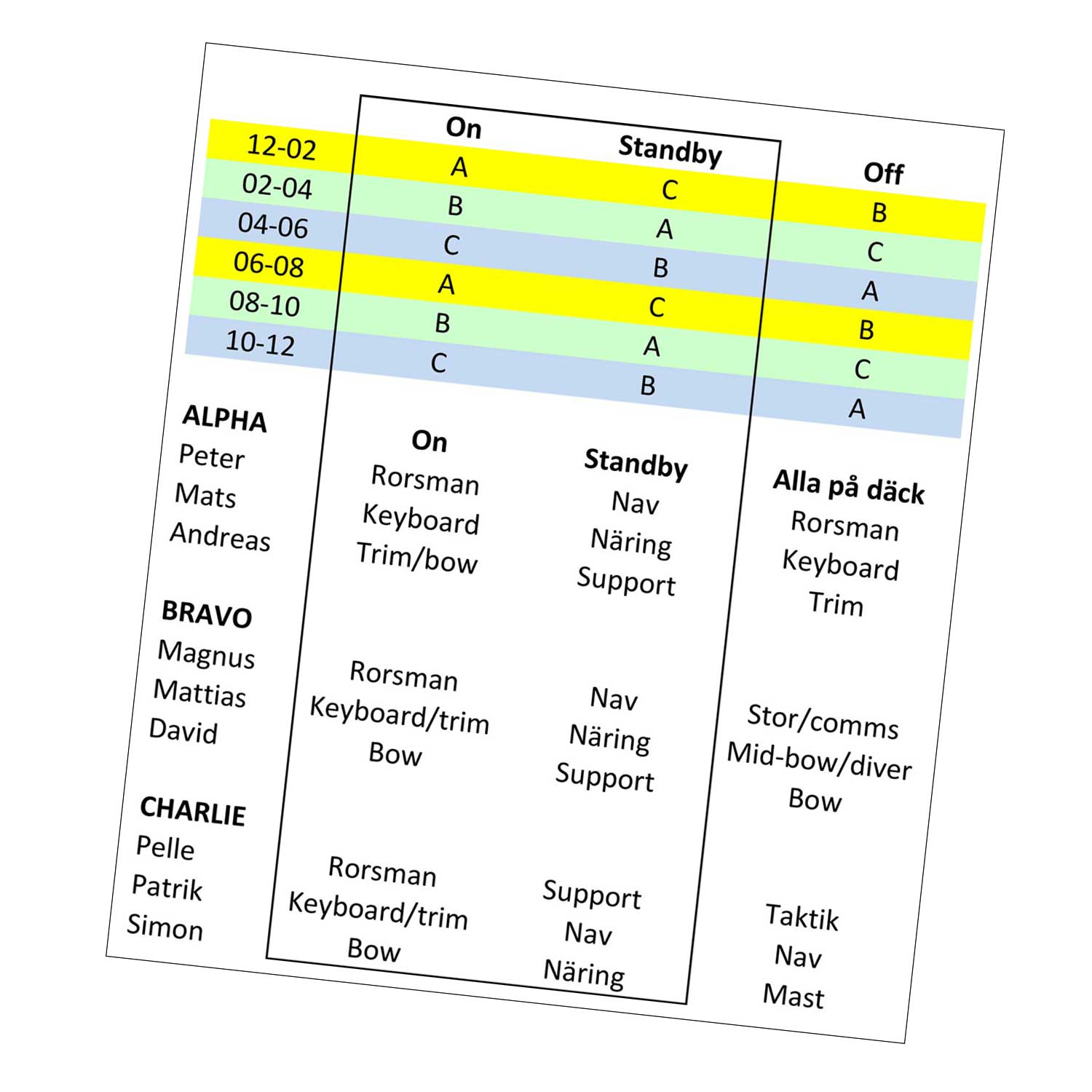
Därför blev ett bra vaktschema en av de absolut viktigaste frågorna, och vi kom fram till att köra tre vakter som roterade med tvåtimmarsintervall.
1. On = ansvar för att driva båten till 100%, med fokus bara på speed och ha koll på behov av eventuella segelbyten ellar andra justeringar. Typiskt är detta en rorsman och en trimmer som kör storen löpande och trimmar om focken när det behövs på kryss, eller trimmar gennakern på undanvind.
2. Standby = man är på däck eller sköter navigation, näring, håller ordning eller gör allt annat som behövs göras. Man är också redo att rycka in om det behövs byta segel eller om någon roll behövs roteras oftare. Men man bör också kunna slappna av efter att ha fokat hårt.
3. Off = innebär sömn i koj under däck. Av med sjöstället och bra sömn på rätt ställe i båten.
Detta kom att funka mycket bra, och precis när man kände att man började tappa fokus så kom det alltid upp nya utvilade personer på däck som kunde köra hårt i ytterligare två timmar. Det kändes som att vi hade blivit ett maskineri, och vi hade kunnat köra ett varv till efter målgång.
Den andra stora lärdomen var att göra sin egen hemläxa. Och inte lite för mycket på lokala “sanningar” eller rock-stars som vet hur det “brukar vara”
Vi lade två dagar på att kartlägga tidvatten, strömmar, kusteffekter och liknande. Då gjorde vi en fiktiv start från startlinje, the Squadron Line, i Cowes då tidvattnet hade samma status som vid vår start på söndagen (det ändras ju lite varje dag). Vi försökte hitta de områden som gav mest medström, och skapa en bild av vad som hände kring uddar och i sund. Det finns ju ganska mycket att läsa i frågan, och vi hade också skaffat oss bra ström-modeller från Tidetech, men vi ville skapa oss en egen bild.
Detta visade sig mycket framgångsrikt då vi hanterade strömmen på ett bättre sätt än många lokala hot-shots, och ledde vår klass vid the Needles. Bra och metodiskt jobb av navigatör/taktiker som gav resultat.
En bieffekt av dessa träningar var också att vi var vana vid sträckan, och kunde segla mer avslappnat under själva racet.
Enjoy the moment!
När man gör så här stora projekt så kan man inte bara fokusera på själja racet. Kanske är det once-in-a-lifetime för några, och då vill man upplava allt runtomkring. Så vi var på plats några dagar innan, och hade ett ganska relaxat program. Kanske finns det de som vill ta med familjen, då måste man få till ett program som passar alla.
Ska installera WiFi-nätverk; mastantenn, ledning i masten, router. Har du några bra tips?
Lösningen vi kör på Blur har sett likadan ett tag, så det borde finnas bättre sätt? Vi kör en Dovado Tiny AC-router som skapar ett lokalt WiFi ombord. Denna ansluter i sin tur till en liten Telia 4G-puck (HUAWEI E5576), till WiFi i hamnen eller till en iPhone) för Internetacess. Fördelen med detta är att man kan byta internetaccess beroende på var man är eller om något skulle hända med 4G-pucken.
WiFi används ju framförallt för kommunmikation mellan H5000 (som ansluts med Ethernet till routern) och vår laptop, men också för att hantera iPad och diverse andra saker som behöver kopplas upp. Det jag funderat på har framförallt handlat om bättre antenn för internetacess… men den lilla 4G-pucken har funkat förvånansvärt bra.
Men, jag kan tänka mig att det finns bättre lösningar 2020?
Det är alltid lika kul att kolla in konkurrenternas segelgarderober, och fundara på styrkor och svagheter. Och hur man själv skulle bestycka en supersportig 35- eller 40-fotare.
Här har gänget på danska Hansen, en Elliot 35 SS som vi tampades med på Sjælland Rundt, delat med sig av sitt sailchart och sin segelgarderob. Vi publicerade vårt här, men jag skall publicera en uppdaterad version med den garderob vi har nu.
Sail crossover
“Do we have anything to put up for this angle and windspeed?…” This is the question we are asking over and over again when racing Hansen 3.5 both inshore, but even more offshore. The type of boat with all its variations in boatspeed require a large inventory of sails to be able to answer the question with a “YES” every single time.
Every sail need to have a large range of windspeeds and windangles to ensure we are not carrying any dead weight in the cabin. This is where our sailmaker, OneSails Danmark, is playing a big part in our project. Sailmaker and saildesigner Sofus Pedersen is sailing on the boat and is monitoring the performance of every single sail before making developments to the designs.
For 2020 season, this is how our sail inventory will look:
Mainsail – with 3 reefs (yes, we do use all of the reefs…)
Jib #1 Light Jib #2 Medium – with 1 reef Jib #4 – with 1 reef
Beside this, we have a trysail and stormjib we hope will never come into use…
We are not taking all the sails every time we go racing. For every race we select the sails we want to carry based on the expected weather conditions and the course we are going to sail. If forecast is light, we might leave the A5 and J4 in the trailer while J1 and A1.5 can stay at home for the more windy forecasts.
Does it look similar on your boat or did you pick some different sails?
In August we installed a Smartune to measure forestay tension (story here). The initial impressions were great; installation was super simple and having the tension on the mast display made communication much easier.
But after sailing Rolex Middle Sea Race and also the Coastal Race in Malta (that hade a very shifty upwind leg) we also had some data to work with. Above are forestay tension (in kg) as a function of TWS (in knots). So in 12 knots of wind, 1400 kg is a good starting point with the J2 jib.
This is just the first iteration, and wee need more date before this becomes a cheat-sheet in the cockpit. But it felt great to be able to convert our experience, and prior references on the backstay, to hard numbers. Also, communication worked very well, and it felt we could be more proactive with backstay tension when we hade the numbers in view rather than behind us…
Me and Martin Gadman from Happy Yachting met with Sam Cray from Cyclops Marine at METS in Amsterdam. It’s always fun to meet entrepreneurs and people from small technichal companies, and this was no execption. They are still iterating on the optimal design, figuring out production and trying to keep up with demand. Often stressful, but always fun and the best stage to be involved in any company.
The three standard models (7/16″, 1/2″ and 5/8″) now have a slightly more rounded design, to prevent spinnaker sheets to get caught. It’s also possible to measure the distance between the threaded stubs, which will make it easier to repicate the original settings when mounting.
I was happy with the first version, but this is even better.
There’s also a new app to set up and communicate with the Smartune.
Cyclops Marine can do custom sizes of the Smartune, as well as custom solutions. Some of the pojects they are working on now are
• Smart tension link: measures and records clew load wirelessly on superyacht headsails to prevent sail damage and provide direct load feedback for safety on captive winches (based on innovative Cyclops fail-safe tension link). • Smart furler: directly measures furler luff load (sail and cable) • Smart headstay ram: directly measures forestay load without the inherent inaccuracies of a loadpin.
Here’s the new Smartlink. Ineos Team UK took delivery of 9 of these last month, with plenty of riggers wanting one to have in their pocket too. This is a concept that they originally produced for Bella Mente for their Mainsheet ring. Available in 2t, 5t and 10t load ratings.
Vi seglade vår första Hollænderseilas 2017, och lyckades långt över förväntan. Efter det blev jag bjuden till Norge för att berätta om våra hemligheter – för på något sätt så har vi fått till det på race som är nya för oss. Hela storyn från Hollændern här.
Föreläsningen, “10 år som nybörjare”, handlade mycket om vår approach generellt, men här tänkte jag dyka jag ner i 3 lärdomar från just det här racet.
Hollænderseilasen 2017
Ha koll på segel & vinklar. Vi har ju lagt ganska mycket jobb på att förstå vilka segel som funkar när (sailchart). I ett lättvindsrace kan rätt segelval när man kommer runt ett märke eller fångar en vindpust lätt göra 500 meter.
På samma sätt så blir sweetspot för undanvindssegel viktigare, då man ofta vill gå riktigt fort i någorlunda rätt riktning och därmed är straffet på att segla i sin sweetspot mindre. Har man inte koll är det lätt att man kanske seglar lite högt/lågt med en gennaker men en knop eller två långsammare än den som kör i sin sweetspot.
I detta race hade vi nytta av detta vid ett antal tillfällen. Framförallt i valet mellan A2 & A3 på undanvind
Trycket är allt. Detta vet vi ju alla, men det tar ofta emot att segla åt “fel håll” i jakten efter mer vind.
Den här gången var vi offensiva, och lyckades hålla dialogen ingång under hela racet. Vi hade tillochmed uppe Johan i masten för att spana efter vind. Mich vi vågade göra våra egna vägval då det stod mer bris mitt i fjorden, när de bästa norska båtarna valde båda de andra kanterna.
Have fun! I lätta vindar så blir ofta stämningen tryckt ombord. Om man fastnar i ett hål, eller om värsta konkurrenten drar iväg på andra kanten. Men skall man segla ett längre race så kan man inte hamna i en negativ spiral när det är lite motigt.
Här lyckades vi hålla energin uppe, och hitta en bra balans mellan 100% fokus på racing, samtidigt som det garvas ombord. Inte allltid helt lätt…
Denna gång med lärdomarna från vårt senaste race i Medelhavet. Hela rapporten här.
Så här ser artikelserien ut.
Tjörn Runt 2009 – om gennakersegling och att lita på oss själva.
Kerteminde Big Boat 2010 – om att bli ett ”lärande team”, näringsintag och att lita på vår boatspeed.
Göteborgs Offshore Race 2010 – om att segla aktivt på havet, segla baserat på data och vitsen med en dedicerad navigatör.
Spi Ouest 2012 – om att ha rätt målsättning, fokusera på lärandeprocessen och inte ha förutfattade meningar
Watski Twostar 2007 – om att kappseglingar ofta avgörs innan start, att man kan segla shorthanded mycket hårdare än vad man tror och att långa race avgörs vid få tillfällen då man måste vara med.
Silverrudder 2014 – om hur man kan segla en båt solo riktigt fort, planering, beslutsfattande och att man orkar mer än vad man tror
Færderseilasen 2014 – om att driva båten 100% även när det blåser, kunna sina sweetspots för olika undanvindssegel och kunna skifta växlar snabbare än andra.
Fastnet Race 2015 – om vaktsystem, att göra sin egen hemläxa och hur man njuter av ögonblicket.
Middle Sea Race 2019 – om teamet och offensiv vs defensiv segling.
Rolex Middle Sea Race 2019
Det är teamet som gör skillnad
När vi utvärderade racet i januari så var det tydligt att vi fått ihop teamet på ett bra sätt. De senaset året har vi jobbat med kommunikation, överlämning mellan vakter och bättre rotation i olika roller. Och att fler skulle ta ansvar, inte bara för sina egna sakert, men också täcka upp där det behövdes och hålla lite extra koll på saker som kunde gå fel.
Nu fick vi verkligen ihop det. Vi kunde rotera på fler rorsmän (5 i stället för 3) och trimmers än tidigare, och fick till roller som var breda och mer dynamiska. Det kändes organisk och bra, framförallt då det blev hårt väder och några var utslagna under en period.
Här var vi mycket bättre än under samma förhållanden på Fastnet.
För mig ledde det också till att jag kunde lägga mer tid och energi på navigation & väder, vilket var nyttigt under de perioder som var intensiva.
I framtiden skall vi försöka få med alla i jobbet, även på längre sträckbogar. Det är lätt att man tappar energin när man bara skall sitta på kanten.
Offensiv vs defensiv segling
På en långt race, med många transitioner så är det svårt att veta när man skall segla offensivt (det finns mycket att vinna om man hamnar rätt på de stora skiften) och defensivt (det finns ännu mer att förlora på att fastna i ett bleke).
I den här upplagan så fanns det framför allt ett stort skift på väg upp mot Messina, där JPK 11.80 Sunrise verkligen spikade högerhörnet och tjänade 20 distans på det. Men det fanns också 5-6 ställen där man kunde parkera och tappa minst lika mycket.
Efter ett antal säsonger med båten, så har vi ganska bra koll på våra starka och svaga sidor. Också relativt två av världens bästa båtar i vårt storleksklass: JPK 11.80 Courrier Recommandé och systerbåten Sunrise med många proffs ombord.
I det lätta vädret under de första 2/3 av racet visste vi att vi hade bra speed mot många andra, och vi kunde pusha hårt på speed, utan att ta för mycket risk. Vi låg nästan alltid på rätt sida om fältet, men gjorde inga “flyers”. Vi visste också att vi kunde gå lite närmare områden med lite vind utan att fastna, och kunde tjäna lite i varje transition.
Under debriefen sa vid att vi seglade “modigt” och vågade göra vår grej. Vi identifierade de tillfällen runt banan där vi behövde fatta viktiga beslut, och kunde i tid resonera kring risker och möjligheter.
Både Courrier och Sunrise gjorde varsin rejäl flyer, och bägge gångerna fick man bra utväxling, men vi ledde ändå klassen när vi kom till västsidan av Sicilien.
After test sailing the new Celeste 34 Sport last weekend, I’ve decided to summarize in two articles. One on deck layout and systems (this) and one on sail plan and performance (coming soon).
Naturally, it’s easier to design and build a boat with just one purpose, and a specific sailor in mind, instead of being a compromise no matter how you use it.
The Celeste is the brainchild of Torbjörn Hurtig (owner) and Gabriel Heyman (designer). Torbjörn wanted the same sailing joy and shorthanded ease that he got in his J/80. But in a slightly bigger package; a sporty 34-footer with gennaker, water ballast, and systems to make solo sailing easy.
Similar thinking got me to the J/111, so it has been fun following the build.
One thing that struck me during the build was Torbjörns attention to details. Especially on deck, both in general layout as well as specification and position of every component.
And after sailing the boat, it’s clear that it works beautifully.
It’s a wide boat for its size, especially aft. Almost looks like a french open-style boat? The cockpit is huge, and it’s easy to move around.
The helmsman kan either sit well aft if he has a main trimmer in front or move all the way up to the winch when alone. It’s easy to run both jib, code and the gennaker sheet to this windward winch, which is perfect when you’re shorthanded. All winches are Pontos Grinder (now Karver) of the same type we use on Blur.
Trimming to leeward is great, as you’re positioned outward, behind the winch instead of inboard. This makes it comfortable to make small adjustments looking at the sail, and I can see that this is a favorite position in light air under autopilot.
The jury is still out on the black “nav console” with plotter, compass, and autopilot controller? Usually seen on 100-footers, it makes sense to grab on to when it gets wild and a great place to put the plotter. But for many, it destroys a clean and minimalist look. I understand both camps…
On the todo-list are proper footrests for the helmsman and main trimmer. My recommendation was to make them bigger, like the bars seen on Melges 40 or Fast 40+, as you will be spending many hours heeled over
Jib sheet. As the cabin is rather narrow there are two low profile tracks with adjustments in/out and up/down. The sheet goes back through a block with a locking mechanism (unlocks by its own weight) as well as a turning sheave to redirect the sheet to windward. It’s also possible to go directly from the fairlead to the cabin top winch.
A very clean foredeck. The jib is on a Bartel under deck furler, the inner jib is on a Karver KMH2 internal halyard lock and KF1 furler with 3:1 tackline. This runs below deck back to the cabin-top clutches. Same setup for the code with a 3:1 tackline at the end of the fixed sprit. The extendable sprit is aligned on the starboard side, with both tackline and sprit outhaul running to the cabin-top clutches.
Note the two recesses where sprit and control lines run. No risk of water down below.
All the thought that was put into this deck layout really pays off.
It makes the boat say to sail, and that will result i earlier sail changes and active trimming.
This is the second article after our test sail a couple of weeks ago. Part one covered deck layout and systems and this time we’ll focus on sail plan and performance.
Sizing of sail plan – using ORC VPP
Reflection – how did it feel
Sail inventory – in-depth on all the sails
One of the things often debated with new boats is sail area vs displacement or other numbers indication horsepower to weight. As with sports cars, you can make a lighter car go with a smaller engine (a la our J/111 that was considered underpowered when it launched) or make a muscle car when you put a V8 into a beast of a car (a la a Class 40).
Finding the right balance is delicate. What’s right for a keen regatta sailor in the archipelago is different from what a cruising family wants for longer cruises.
For Torbjörn Hurtig, the owner, it was clear that he wanted to bring the J/80 experience into a bigger package. So plenty of horsepower.
In a bigger project, there’s usually a big budget and lots of computer power to figure this out. Instead, the project team with North Sails, Seldén, Gabriel Heyman, and Torbjörn decided to use the ORC VPP to run a range of rigs to see how the boat performed in different conditions but without bringing the rating itself into the equation.
Boat speed in different wind strengths. It’s clear that the boat would benefit from a taller rig in 6-8 knots, typical Scandinavian summer-conditions. And there’s a real risk of becoming underpowered.
Looking at heel, reef and flat it’s also easy to see when the boat becomes overpowered and you need to reduce sail.
An additional benefit is that you get crossovers straight out of the ORC Speed Guide as well as target speeds.
The same tools are used to optimize an existing boat and it’s possible to run many sail & weight combinations, trying to figure out if you get more speed vs the rating hit. Or not.
Enough with the theory.
How did it sail? Was it overrigged?
We had SW 14-18 knots with 20 in some puffs. So potentially overpowered without a crew or water ballast?
But she behaved very well, balanced and actually easier to handle than a J/111 in the same conditions. I was somewhat surprised, as I expected the sail plan to be a bit much in these conditions.
With water ballast, full main and the big jib will work great in 16 knots, at least with active trim and a good autopilot.
We also tried out the inner jib that looked great. But it will probably come into play when the wind is steady at 18-20 knots.
Going back home, we hoisted the 108 m2 A3. Plenty of punch in the gusts and we touched 14 knots. We also tried some broaching . This will be a fun ride downwind both in light air, and when the boat gets on a plane. Also in combination with the big 130 m2 A2, there will be plenty of power in most conditions.
Overall, pleasantly surprised.
Good job by everyone involved.
Photo from the first test sail with the builder & designer.
Main
3Di Endurance 760 S 14,700 Dpi, 40,2 m2, ORCi 38,67 m2 Endurance 1010 – White
Note the big roach with several longer battens but just one full length at the top. Very similar to the ClubSwan 42? Supposed to give both control as well to be easy to tack/gybe in higher winds without getting stuck. Looks cool!
J2 Allround Jib
3Di Endurance 760 S 14,700 Dpi, 32,9 m2, ORCi 31,63 m2 Endurance 1010 – White Vertical battens 3D Furl Only Structure (no reefing) Headsail Half Reef (reaching clew) Soft hanks
Designed with a sweet spot at 12 knots, but the structure should take some beating in more wind.
Det är lätt att hävda att man vill ha en båt bara för att det kul. Men ganska snart blir man sugen på att få ut den potential som finns. Och så var det när vi fick låna en Dominant Race Special över sommaren.
Jag skall försöka sammanfatta våra erfarenheter och hur vi gick till väga. Kanske finns det något användbart för andra i samma sits.
Tidigare har jag berört ämnet i “Getting up to speed?” (2010) och “7 steg för att få upp farten” (2014) och säkert på många andra ställen. Jag har ju hävdat att man behöver ge en större båt tre säsonger innan man har koll, men Dominanten känns ju enkel och ganska straight forward?
Grundförutsättningarna var:
Segla med det vi har – inte spendera massa pengar på nya grejer
Fokus på solo (Midsummer Solo) och doublehanded (Pantaenius Bohusracet)
Kunna ge strukturerad feedback till båtägaren.
Rigg
Efter första provseglingen utanför Långedrag så blev två saker tydliga; mycket rodertryck och ett storsegel som hade sett sina bästa dagar. Vi behövde få fram buken, och genom mastböj gå från ett kraftfullt segel i lättvind till ett så platt segel som möjligt i mer vind.
Åtgärden blev att vi kortade förstaget med 35 mm (så mycket det det gick) och rätade upp masten. Gissningsvis hade vi 40% mindre prebend (= lite mindre än 1 sektionslängd). Generellt hårdare masttrim, framförallt i undervanten för att få mer/fram buk i nedre delen av masten. Eftersom vi kör längre race kan vi inte justera riggen hela tiden, utan vi ville hitta något som funkade i alla förhållanden.
Vi behövde också förlänga häckstaget för att hantera en rakare mast.
Det tog två tillfällen för att hitta rätt läge.
Här skall man inte vara rädd för att prova. Anteckna bara var ni startar, så går det alltid att gå tillbaks.
Segel
Kryss-stället är ett North 3DL med 10 år på nacken. Ägaren väntar på leverans av ny stor och fock, så det här skall väl hamna i containern när vi är klara med det. Största oron var så klart om det skulle delaminera helt och gå rakt av
Ovan storen efter riggjusteringar och med släppt häckstag.
Focken var formmässigt ok, och det enda vi behövde göra var att byta till styvare lattor (de som satt i ovan hade tydligen hamnat i seglet av misstag). Lite märkduk där det var som mest delaminerat blev det också.
Sedan lade vi en del tid på att lista ut vilka undanvindssegel som fanns, vilka vinklar de fungerar inom och vad som kanske skulle kunna vara sweet-spots. Detta funkar bra med bara en kompass ombord; segla så högt det går på ena bogen, gippa och gör samma sak på andra. Sedan seglar man så lågt det går och gör samma sak.
Här hade vi initialt en topphissad spinnaker och en gennaker som såg ut som en A3-variant (bra mellan TWA 110 och 140) men dessa segel fick läggas i land efter vårt mastbrott:
Så till slut slutade vi med garderoben i SRS-brevet nedan; 1 partialhissad symmetrisk spinnaker och en code med 60% halvbredd. Denna mappade ganska väl mot de vi sett på Blur; TWA 60-65 i riktigt lätt, men typiskt TWA 80-120 där spinnakern sedan tar över på ett bra sätt.
Löpande rigg
Är det något jag är petig med så är det löpande rigg. Att fall inte töjer sig, att linor löper lätt och sitter i råttor och avlastare. Och inte är slitet.
Hör valde vi att byta allt för att vara på den säkra sidan. Det mesta i Liros Magic Edge, en lina som funkar till både fall och trimlinor för att göra det enkelt. Svårast är att få till bra färgkombinationer.
Spinnskoten är samma som vi kör på Blur, fast tunnare dimensioner. De special-görs på beställning men en tunn och lätt Dyneema närmast spinnakern, snygg övergång, och tjockare greppvänligt i andra.
Sheets
Qty
Diam
Length
Quality
Colour
Jib Sheet
1
8
16
Liros 2027 Racer Vision
steelblue/orange
Main Sheet
1
8
20
Liros 2027 Racer Vision
steelblue/orange
Spinnaker Sheet
2
8-4 mm
19
Liros 02049 Spinsheet Pro
green + red
För stor och fock kör vi Liros 2027 Racer Vision. Lite hårdare, vilket gör att den inte trasslar så lätt.
Passade också på att göra nya stroppar i Dyneema och gjorde om de lashings som fanns. Skönt att veta hur saker sitter fast.
Däckslayout
En av de uppgifter vi har fått är att titta över däckslayouten för att göra den mer solovänlig.
Det är väl egentligen inget fel på hur saker sitter, men är målet att segla båten effektivt solo så finns det en del saker man kan göra.
Vi tittade bland annat på hur vi skulle kunna skota focken i relingen på halvvilda, men bestämde oss för att den långa självskotningsskenan gjorde jobbet på ett bra sätt.
Till sist körde vi båten i stort sett som den var, men har en liten lista på saker som vi hade gjort om det var vår båt:
Storskotsskenan bör flyttas ner på durken + fram ca 50 cm. Här bör både skotvagn och häckstag dras till ungefär samma plats på insidan av sittbrunn. Det för att rorsman kommer nästan en meter längre fram.
Rorkulten skulle kunna förlängas en bit,
Winshar flyttar fram ca 50 cm.
Fockskot skulle kunna ha råtta på sidan av ruffen, där suggan sitter nu, och kan antingen skotas där eller på winsch. Ett alternativ är att ta bort selftacker-skenan och köra en överlappande fock. Det hade antagligen gett lite med bett på kryss.
Uthal kan mycket väl sitta på undersidan av bommen (justeras sällan).
Kick och cunningham bör ha dubbelkommando.
Plus säkert nåt jag missat just nu…
Botten
Behövde bara en dykning och tvätt med svamp.
Elektronik
Båten hade Raymarine logg, lod och autopilot. Vi kompletterade med en lånad Sailmon MAX för kompass och GPS-fart (separat test kommer).
All navigation gör vi på båtsportkort och en liten iPad med Seapilot och Navionics. Vi provade också lite olika monteringssätt (ovan). Men oftast är den lös.
SRS
Efter mastbrottet så blev SRS enligt nedan. Högt på en så liten båt, men uppenbart möjligt att segla upp till.
Dominant Race special (Gösta Edwardson och Lennart Palén)
Dominant Race special har byggts i 3 stycken exemplar och är en vidareutveckling av den ”vanliga” Dominant Race som främst finns på västkusten. Båten är snabb, (Lys 1,22) och livlig men lättseglad och planar villigt med spinnaker på undanvind. Eftersom ”Original-racen” redan hade en fullt modern skrovform behövde inga ändringar göras i linjeritningen. Alltså kunde man använda de redan befintliga gjutformarna för skrov, däck och basinredning när den nya båten byggdes. Däremot gjordes omfattande ändringar beträffande byggmaterial, köl och roder, samt rigg och segelplan.
Material Skrov och däck är handupplagda med biaxiella mattor, där det mesta av fibrerna är diagonalt orienterade för vridstyvhet. Matrisen som använts är en avanserad ISO-polyester med en brott-töjning på 6,5%. Båten är en sandwich-konstruktion i både skrov och däck med 10 mm Divinycell (H-100) som distansmaterial. Firetmatta utgör distansmaterial i sargar, kojfronrter och luckor. Kraftiga skott och förstyvningar tar upp lasterna från riggspänningen. Kölinfästningen är mycket kraftigt dimensionerad.
Ytbehandling Friborden är lackerade med 2-komponent polyurethanfärg för bättre slitstyrka och lättare renhållning än med gelcoat. Däcket har gelcoat för att lättare kunna repareras lokalt vid småskador. Bottnen är primad med 5 lager lösningsmedelfri epoxy.
Lateralplan Kölen är trapetsformad med bulb och är 35 cm djupare än originalkölen (1,65 m). Kölarean är 2,3% av kryss-stället. Den har en modern vingprofil av höglyftstyp (10% tjock). Bulben har en laminärprofil som skiljer sig markant från originalet. Rodret är också djupare (1,40 m) med en rotkorda på endast 32 cm och en modern höglyftsprofil (12% tjock). Rodret är byggt i glasfiber och epoxy på skumkärna.
Rigg Partialrigg (5/6) med dubbla bakåtsvepta spridare (18°) och fiolstag (Inga backstag). Masten är av lättmetall (Benns H-5) med konad topp. Spridarfästen, spridarnockar, fiolfästen och bombeslag är alla Custom-tillverkade. Stobom och spinnbom är båda gjorda i kolfiber. Den senare har beslag av armerad nylon i nockarna och är mycket lätt. All stående rigg är i RF-wire med valsade kardel (Dyform) för större stålarea. Alla fall är i Dyneema utom toppspinn-fallet som är i polyester för att mer töjning är önskvärt där.
Segelplan Storseglet är väl tilltaget (22 m2) med ordentlig akterrunda och topplatta i full längd. Focken är självslående (12,6 m2) med tre stycken tunna fullängdslattor. Ingen överlappande genua behövs och röstjärnen är därför placerade längst ute vid relingen. Självslående stormfock (7 m2) finns också. Två spinnakrar finns, varav en topphissad (ca: 70 m2) och en vanlig (ca: 45 m2).
Däckslayout Beslagens placering är mycket genomtänkt! Alla trim har dubbelkommando och kan nås från båda sidor. Även fockskotet har dubbelkommando och kan alltid skotas från valfri sida. Alla block från Harken. Alla skotlås från Ronstan (C-cleat), Lewmar fallavlastare (4 stycken) Lewmarwinchar (3 stycken) Skotskenor och travare från Lewmar. Tågvirke i Dyneema och polyestersilke.
Pentry Flyttbar modul som kan placeras var som helst, med 2 stycken lättvikts-gasolkök & reservflaska. Båten har mycket stora stuvutrymmen för proviant, sjökläder och övrig utrustning.
Elsystem och navigation Lätt batteri (30ah) Smidig batteriladdare. Landströmsuttag, Uttag för mobilladdare och GPS. Ruffbelysning, Kompassbelysning, Trefärgslanterna. Kompass (Plastimo Contest)
Motor Nissan 2,5 hk i bra skick (Fullt tillräcklig) Custom tillverkat motorfäste i lättmetall. Förvaringsfäste för motorn under akterdäck. Reservdunk i plast (5 lit.)
Jag sprang på Anemomind på METS 2015. De hade skrivit mjukvara och byggt burkar för att samla data från segling som bearbetades i molnet och sedan kunde hanteras av an app. Snyggt tänkt, även om detta är en liten marknad full med entusiaster (ex SailMon, Racegeek, Vakaros och några till).
Nu har man fastnat lite i kommersialiseringen, och bestämt sig för att dela med sigh av koden.
Här (GitHub) kanske det kan finnas något intressant för er som är lite tekniskt lagda?
Kan det bli en liten community kring detta, så kanske man hittar en väg framåt.
Dear sailors,
Despite this pandemia period, I allow myself to contact you in the name of the Anemomind team.
After more than 5 years of Anemomind activities, we reached an important step. Our sales did not allow us to improve our products as expected nor to fund new developments. However, our tools are still being used and we decided to transform our commercial adventure into a community one.
A first and important step in that direction is the opening of our source code, the majority of which is henceforth available here.
You can easily deploy a clone of our web platform Anemolab on your computer. The Anemobox firmware is also on Github. Our iOS app, Anemomind Connect, will follow soon.
The second step depends on you! Do you want to further use Anemomind products? What kind of evolution would you like for them? How could you participate?
If there is enough interest, we may create an association.
Please note that existing Anemomind clients will be able to use our services at least until 2020. At the moment, Anemolab services are guaranteed.
Do not hesitate to reply to this message to tell us about your reaction, your wishes or propositions.
Kind regards, Julien Pilet, for the Anemomind team.
I might as well admit it: I’m an instrument sailor
On the J/111 we did our homework and ended up with a B&G H5000 system (background).
And when we got an older Dominant Race Special on loan for the summer, we were a bit lost without numbers. So when Sailmon wanted us to test the new Salmon MAX, we jumped on the opportunity.
It’s been 10 years since I got my first Velocitek ProStart (actually started to import them to Happy Yachting in 2010). But even if the core functionality is similar, a lot has happened in tech since then.
Stay with me to the end, when I get into future functionality.
What I like
Display & form factor. The unit itself feels nice, with rubberized sides and a plastic backside that fits nicely into the two different mounts I got with the unit. The 4,4″ display is very nice both in direct sunlight and in the shade. The numbers are big enough. I had some issues with polarizing sunglasses, but nothing I couldn’t manage.
Interface (when sailing). Very intuitive, and my crew immediately got the hang of it without any instructions. It’s easy to flip through the pages and the starting line functions are intuitive. If it’s the first time pinging a line and trying to use the early/late indicator, it can be confusing, but when you understand the math behind it it’s not that hard (it works ok when you’re approaching the line in a consistent way).
The data you can get on the different pages.
Battery. Built in 3600mAh lithium-polymer battery. Charging is wireless and works great at home (not as easy on a 25′ sport boat offshore). Specs says >24 hours. We got 16 hours out of ours (might be slight discharge when turned off on our way to the regatta).
What I don’t like
Interface (set up). Being 2020, everything is connected. The MAX uses both Bluetooth and WiFi (any network or using your phone as a hot-spot). I had a hard time figuring out what interface is used for what, and also there are different settings to be made in the unit and in the app.
I can understand the design choice that the unit should be able to be used standalone, but having to go through an archaic menu system to do basic stuff feels strange when you just connected with a smartphone? I configure all my other gadgets on board with an app for a reason; the Victon BMS/charger/solar regulator, the GoPro, the DJI Mavic Air, and my Withings smartwatch!
It’s also obvious that the app is an early version as I encountered a few bugs (and it doesn’t work on iPad which is strange), but nothing that stopped me from doing what I wanted.
The big thing for me is really sharing. I understand that Sailmon is trying to build a community here, where you need the app to view “friends”… But I just want to share my track on Facebook after a race or take a quick screenshot. Now I can export a CSV file and maybe display it in some other way… I gave up and haven’t shared anything. Maybe anyone got some good advice here?
I really liked the tracks I got from the Sentinel “connected boat device”, Here I just zoomed in and selected the part I wanted to share.
Documentation seems to be work in progress. A lot of the info is shared through webinars & videos (and in a thread on Sailing Anarchy). Should just be in a really good “users guide” matching the great looking packaging/website.
If this was the first effort from a new company (like Racegeek) I wouldn’t care, but Salmon is now an established brand and expectations are suddenly higher
Wish list
After the start gun, it would be easy to keep “distance to line” for 5 or 10 seconds. That way I would see if I were early (or late). Now it instantly switches to the page I pre-selected.
Easier way of sharing tracks.
But, what is it?
OK. So MAX could be a modern version of a ProStart. Or very much more. There’s already a Bluetooth, solar-powered, ultrasonic wind sensor available (Calypso) for €499, and listening in on the webinars, there seem to be all kinds of stuff on the horizon. As the B&G WS320.
There’s also a checkbox to get “NMEA0183 OUTPUT” from the unit. Not really sure how to take advantage of that yet…
Sailmon MAX is obviously something more than a modern ProStart. But I’m not really sure what I’m buying into here – or where future updates will take me?
I know that it’s hard to launch a new product, and it’s often a good idea to get something on the market to get user feedback. But it’s also very easy to miss your core segment by trying to do too much for too many. And not being super clear on what problem you’re solving.
But so far: well done and good luck to the team at Sailmon.


 Here’s a great piece from between 1972-1974.


 “CELERITY II” a Cal 33 won the St. Pete to Ft. Lauderdale Race in 1972 with all North sails. Her large genoa staysail is used effectively by disconnecting the leeward lower shroud (now illegal under IOR rule). A better arrangement is a mini spreader for the lower shroud.
 The double head rig can be a good way to add power to relatively short rigged CCA designed boats.






 . This will be a fun ride downwind both in light air, and when the boat gets on a plane. Also in combination with the big 130 m2 A2, there will be plenty of power in most conditions.


